Bone Grafting
Bone grafting may help rebuild support in areas where bone volume has been reduced before or during implant treatment.
Explore Bone Grafting →Chicago Dental Care
Dental implants can replace missing teeth with a treatment plan designed around function, stability, bone support, and long-term maintenance. Full Smile Family Dentist provides implant consultations and treatment planning at our Chicago office on W. Fullerton Avenue.
Treatment recommendations depend on an examination, current imaging when appropriate, medical history, and the condition of your teeth and gums.Personalized Dental Care in Chicago
A dental implant is a small biocompatible post placed in the jawbone to support a replacement tooth or another dental restoration. After the implant integrates with the surrounding bone, it can be restored with an implant crown, bridge, or selected prosthetic option depending on the number and location of missing teeth.
Implant treatment starts with diagnosis, not with surgery. Your dentist evaluates the missing-tooth area, gum health, bite, available bone, neighboring teeth, medical history, and your goals. Digital X-rays and three-dimensional CBCT imaging may be recommended to evaluate the anatomy in greater detail and help plan treatment safely.
Not every patient needs the same sequence. Some people have enough bone for straightforward implant planning, while others may need extraction-site healing, bone grafting, periodontal treatment, or another preparatory step. The final plan and timeline are reviewed with you before treatment begins.
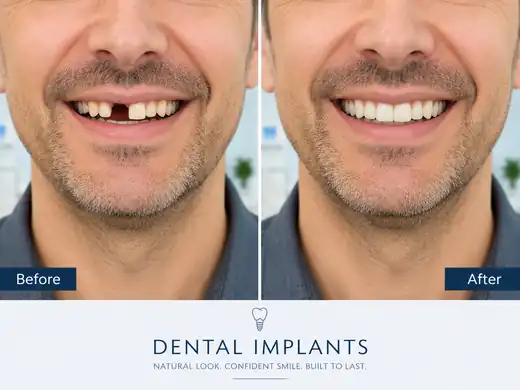
Dental Implants Before & After
Dental implants can replace missing teeth with restorations planned to support function, appearance, and a natural-looking smile. Implant treatment depends on bone support, gum health, healing, bite, and individualized treatment planning.
Illustrative example: The before-and-after image shown is an illustrative example, not an actual Full Smile patient result. Individual outcomes vary.
Candidacy
Implant candidacy depends on more than age. The dentist considers your overall and oral health, available bone, gum condition, smoking or nicotine use, medications, healing factors, bite forces, and ability to maintain the area. Certain medical conditions or medications can affect treatment planning, which is why a complete health history is important.
If a tooth is still present but has a poor prognosis, the dentist will also discuss whether saving the tooth is realistic before recommending extraction and implant replacement. When an implant is appropriate, the objective is a restoration that is cleansable, functional, stable, and compatible with the surrounding tissues.
Technology
Traditional dental X-rays provide valuable two-dimensional information. For selected implant cases, cone-beam computed tomography, or CBCT, provides a three-dimensional view of the jaws and surrounding anatomy. This can help the dentist evaluate bone dimensions and important structures before determining implant position and size.
Our Chicago office also uses digital imaging and intraoral scanning. Depending on the case, these tools can support restorative planning and help patients better understand the proposed treatment.
Bone Support
Bone naturally changes after a tooth is lost or removed. In some areas, the remaining ridge may not have enough width or height for the preferred implant position. Bone grafting may be recommended to preserve or rebuild support before or during implant treatment.
The type and timing of grafting vary. Some grafts are performed at the time of extraction, while others are completed as a separate procedure and allowed to heal before implant placement. Your dentist will explain whether grafting is recommended and what it means for the overall timeline.
Restoration & Maintenance
After integration, an implant typically supports a restorative component such as a crown. The shape, bite, contact with neighboring teeth, and cleansability of that restoration are important to long-term function. Implant-supported bridges or other prosthetic designs may be considered when multiple teeth are missing.
Implants are not immune to inflammation or bone loss. Daily plaque control, professional maintenance, periodic examinations, and monitoring of the bite remain important after treatment. Patients who grind or clench may also be advised to use a protective appliance depending on the case.
Cost & Coverage
Dental insurance coverage for implants varies significantly. Some plans provide an implant benefit, some cover only portions of the restoration, and others exclude implant treatment. Annual maximums, missing-tooth clauses, waiting periods, replacement limitations, and medical necessity requirements may apply.
Our team can help review available benefits and discuss estimated patient portions. Financing options include Sunbit and CareCredit, along with cards, cash, Weave Pay, and available in-house arrangements. Financing approval and terms are determined by the financing provider.
Common Questions
The timeline varies. Some cases require extraction healing or bone grafting before implant placement, and implants generally need time to integrate with the bone before the final restoration. Your dentist can give you a more specific sequence after an examination and imaging.
Not everyone does. A bone graft may be recommended when the available bone is not sufficient for the planned implant position or when preserving the ridge after an extraction is beneficial.
Local anesthesia is used for implant procedures, and comfort options are discussed before treatment. Soreness after surgery varies by procedure and patient. Your dental team will provide post-operative instructions and explain what symptoms should prompt a call.
The office has CBCT technology and may use three-dimensional imaging when clinically appropriate for implant evaluation and planning.
Some dental plans provide implant benefits, while others exclude them or limit coverage. Benefits may also differ between the implant placement, abutment, crown, grafting, and related procedures. The office can help review available plan information.
Full Smile Family Dentist offers access to Sunbit and CareCredit and accepts major cards, cash, Weave Pay, and available in-house payment arrangements. Financing approval and terms depend on the provider and individual application.
Related Care
Bone grafting may help rebuild support in areas where bone volume has been reduced before or during implant treatment.
Explore Bone Grafting →Custom crowns can strengthen, protect, and restore teeth affected by large fillings, fractures, or extensive decay.
Explore Dental Crowns →Partial dentures replace several missing teeth while using the remaining teeth for support and stability.
Explore Partial Dentures →Plan Your Visit
Review accepted insurance information and explore Sunbit, CareCredit, secure online payments, and other available ways to manage dental treatment costs.
Plan Your Visit
Schedule an implant consultation at Full Smile Family Dentist to review your missing-tooth area, imaging, bone support, treatment sequence, insurance questions, and financing options.